

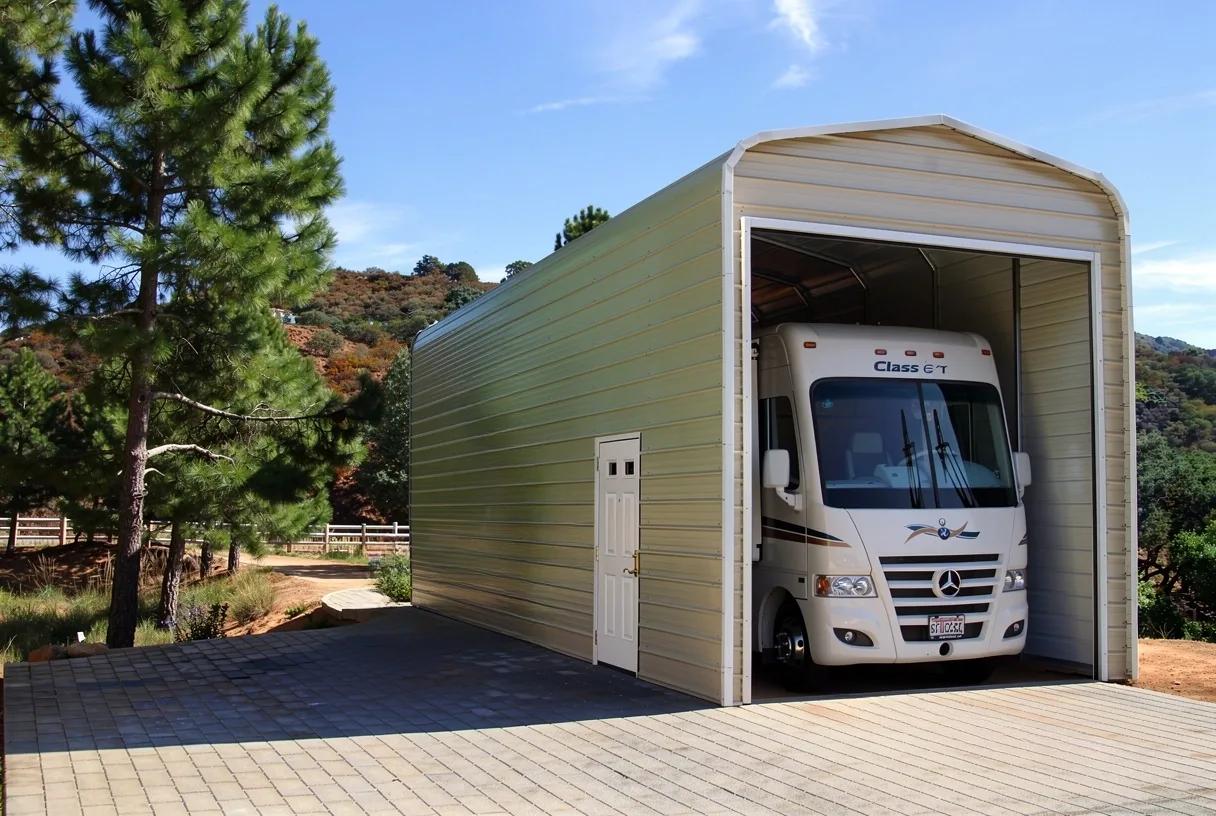
Every RV owner eventually faces the same fork in the road: build a fully enclosed RV garage, or put up an open steel RV cover? Both beat leaving a six-figure rig in the sun. They just solve the problem at very different price points.
We build both, so here’s the honest framework we walk customers through on site visits.
Choose an RV cover if your main enemies are sun, heat, and hail — it delivers ~80% of the protection for a fraction of the cost. Choose an RV garage if you want dust-free storage, security, a climate-controllable space, or maximum resale protection for a premium rig. Many owners start with a cover and enclose it later.
What Each One Protects Against
| Threat | RV Cover (open) | RV Garage (enclosed) |
|---|---|---|
| UV / sun damage | Excellent | Excellent |
| Hail | Excellent | Excellent |
| Rain & snow load | Very good | Excellent |
| Dust & windblown grit | Partial | Excellent |
| Theft & vandalism | No | Yes, lockable |
| Rodents | No | Sealed = far better |
| Climate control option | No | Yes |
The Cost Logic
An enclosed RV garage costs a multiple of an open RV cover of the same footprint — walls, a 12–14 ft roll-up door, and heavier engineering add up. The question isn’t “which is cheaper” (the cover, always) — it’s whether the extra protection matches your rig and your plans.
- Cover math: $150k+ motorhome parked at home, dry climate, gated property → the cover handles the big killers (sun and hail) at the lowest cost.
- Garage math: full-timing rig, dust-prone lot, long storage periods, or you want a workshop bay alongside → the garage pays for itself in preserved value and utility.
Build the cover with garage-ready specs — vertical roof, full-height legs, base rail placement — and you can add walls and a door in a later phase. We design covers this way on request at no extra design cost.
Sizing Rules That Apply to Both
- Height: tallest roof accessory + 18–24 inches of clearance — measure the AC unit, not the roofline.
- Length: rig + 4–5 feet so you’re not threading a needle.
- Width: add a bay now if you’ll ever own a second vehicle or need a shaded work area — widening later is costly.
Slide-outs change the math: if you plan to open slides in storage, the structure needs width for the extended footprint, not the driving footprint.
RV Garage vs. Cover: FAQ
Which one needs a permit?
Both, in most CA and AZ counties at RV sizes. Engineering and permits are part of every Steel Strux project either way.
Can I add solar panels on top?
Yes — both structures make excellent solar platforms, and a vertical-roof design with proper purlin spacing takes panel mounting cleanly. Tell us during design.
What about a partially enclosed cover?
A popular middle path: roof plus one or two side panels blocks low-angle sun and windblown dust for modest extra cost — without the full garage price.
Not sure which way to go? That’s what the site visit is for.
We measure your rig and property, price both options, and you pick with real numbers — free, no obligation.
Schedule Your Free On-Site Visit →Serving Southern California & Western Arizona · (888) 820-4992